2.3.1Management Board Remuneration Policy
Introduction
The Remuneration Policy 2022 (RP 2022) became effective January 1, 2022 after being adopted by shareholders with 91% of the votes on April 7, 2021. Pursuant to Dutch law, at the 2025 AGM, the Remuneration Policy 2026 (RP 2026) was submitted to the shareholders and adopted with 97.54% of the votes on April 9, 2025. RP 2026 is effective on January 1, 2026. Reporting in this remuneration report takes place on the basis of RP 2022 as it was effective in 2025. Full details and the principles and rationale for the RP 2022 and RP 2026 are available on SBM Offshore’s website (who-we-are/corporate-governance).
The Company remunerates members of the Management Board for long-term value creation. RP 2022 is based on competitive remuneration aligned with the long-term performance of SBM Offshore. It is built on six reward principles: simplicity, flexibility, predictability, competitiveness, alignment and, most importantly, driving the right results.
This remuneration report has been written based on the EU Shareholder Rights’ Directive (SRD II) as implemented in the Netherlands.
Explanation of RP 2022
SBM Offshore is the world’s deepwater ocean-infrastructure expert. Under advancing the core, SBM Offshore remains dedicated to its core activities while striving to advance towards a net-zero future. To support this, SBM Offshore develops ocean infrastructure solutions promoting the decarbonization and increasing efficiency of traditional oil and gas production through proven and progressive ocean infrastructure expertise. By pioneering more, SBM Offshore applies its capabilities to unlock new markets within the blue economy. In executing the strategy, SBM Offshore is guided by its Core Values: Integrity, Care, Collaboration and Ownership.
The underlying principles of the remuneration policy of the Management Board of SBM Offshore N.V. support the vision and ambition, and aim for sustainable long-term value creation for SBM Offshore through the Value Creation Stake balanced with pay for performance through the short-term incentive (STI).
The Company’s strategy revolves around excellence in the execution of ocean infrastructure while reducing costs and emissions from oil and gas production and, in parallel, developing new lower-carbon solutions with unwavering dedication to health, safety, and protection of the environment. In RP 2022, pay is linked to the strategic goals through the STI performance areas of Profitability, Growth and Sustainability performance through annual financial, non-financial and sustainability targets for the respective performance year. As such, Management Board remuneration is directly linked to the success of the Company and the value delivered to shareholders. Sustainability is an integral part of the strategy, and is explicitly expressed through the Sustainability performance area and also through the underpin test for the Value Creation Stake.
Employment conditions and pay of employees within SBM Offshore are taken into account when formulating the remuneration policy, for instance through the internal pay-ratio analysis. Employment conditions for Management Board members may differ from those applicable to employees because their responsibilities are on a different level. The principles of the remuneration policy applicable to the Management Board are used as a guideline for remuneration at SBM Offshore as a whole.
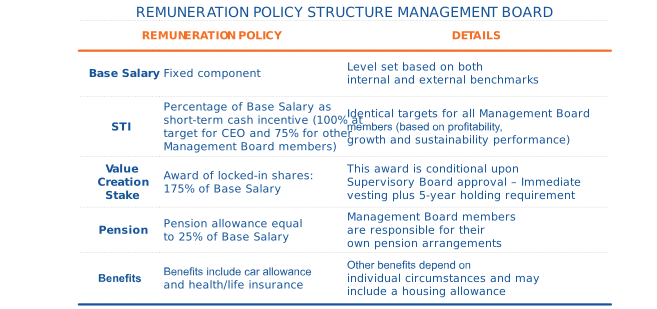
The four components of the remuneration package of Management Board members under RP 2022 are: (1) base salary, (2) STI, (3) Value Creation Stake and (4) Pension and Benefits.
Base salary
The base salary is set by the Supervisory Board and is a fixed component paid in cash. Depending on internal and external developments such as market movements, the Supervisory Board may adjust base salary levels.
Short-Term Incentive
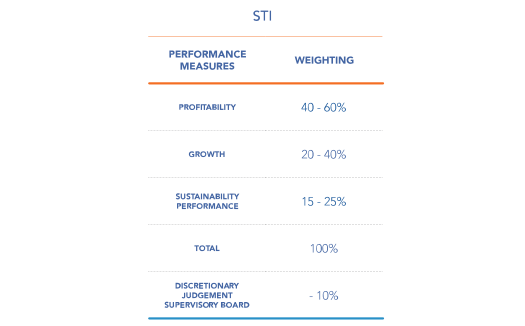
The objective of the STI is to provide a direct alignment of pay with short-term operational performance. Under RP 2022, the STI key performance indicators focus on three performance areas: (i) Profitability, (ii) Growth and (iii) Sustainability performance. The Supervisory Board, upon the recommendation of the Appointment and Remuneration Committee, determines the specific performance targets for each of the performance measures in the beginning of the financial year. The weight awarded to each of the performance areas is set within the following ranges:
The Supervisory Board will inform the shareholders in the remuneration report of the performance delivered in the reporting year on the targets set for the three performance areas and the corresponding pay-out awarded to each of the Management Board members. Performance measures will not be adjusted retrospectively.
Performance ranges – threshold, target and maximum – are set for each of the key performance indicators. The STI is set at a target level of 100% of the base salary for the CEO and 75% of the base salary for other Management Board members. The threshold pay-out is at 0.5 times target and maximum pay-out will not exceed 1.5 times target. A linear pay-out line applies between threshold and maximum. Performance below threshold results in zero pay-out. The Supervisory Board may adjust the outcome of the STI down by a maximum of 10%, which adjustment, if applied, will be reported on in the remuneration report.
At the end of the performance year, the performance delivered is reviewed by the Supervisory Board and the pay-out level is determined. Target setting and realization are published ex post in this remuneration report. For order intake and project performance that are very sensitive commercially, a qualitative appraisal will be presented. The STI is payable in cash after the publication of the Annual Report for the performance year.
Value Creation Stake
The Value Creation Stake is an award of restricted shares to create direct alignment with long-term shareholder value. The awarded shares must be held for at least five years. After retirement or termination, the holding period will not be longer than two years. The gross annual grant value for each of the Management Board members is 175% of base salary. The number of shares granted is determined by using a four-year average share price (volume-weighted). The Value Creation Stake has a variable element to the extent that the share price develops during the holding period and includes performance underpins. The underpin serves as a mechanism to ensure an acceptable threshold level of performance. Prior to the grant of the Value Creation Stake, the Supervisory Board can consider that it is withheld in full or in part when events within control of the incumbent Management Board have occurred that threaten the long-term continuity of the Company, in case of:
- Safety event resulting in the loss of multiple lives and/or significant oil damage to the environment and/or loss of an FPSO; and/or
- Compliance issue resulting in the Company being unable to operate in one or more of its primary markets; and/or
- Significant project impairment due to insufficient oversight or gross negligence or deliberate omissions. This relates to large projects with a value exceeding US$1 billion.
All members of the Management Board are required to build up Company stock of at least 350% of base salary. The value of the share ownership is determined annually at the date of grant.
Pension
The Management Board members are responsible for their own pension arrangements and receive a pension allowance equal to 25% of their base salary for this purpose.
OTHER BENEFITS
The Management Board members are entitled to additional benefits, such as a company car allowance, medical, disability and life insurance and (dependent on the personal situation of the Management Board member) a housing allowance and school fees.
key elements employment agreements
Each of the Management Board members has entered into a service contract with the Company, the terms of which have been disclosed in the explanatory notes for the General Meeting at which the Management Board member was (re-)appointed.
Adjustment of remuneration and claw-back
The service contracts with the Management Board members contain an adjustment clause giving discretionary authority to the Supervisory Board to adjust the payment of the STI, if a lack of adjustment would produce an unfair or unintended result as a consequence of extraordinary circumstances during the period in which the performance criteria have been, or should have been, achieved. Based on earlier shareholder feedback, the Supervisory Board determined that upward adjustments will not be considered.
A claw-back provision is included in the service contracts, enabling the Company to recover the STI and/or LTI on account of incorrect financial data.
Severance Arrangements
The Supervisory Board will determine the appropriate severance payment for Management Board members in accordance with the relevant service contracts and Corporate Governance Code. The Corporate Governance Code provides that the severance payment will not exceed a sum equivalent to the annual base salary. This also applies in a situation of a change in control.
Loans
SBM Offshore does not grant loans, advances or guarantees to its Management Board members.