3.2.2Emissions
ESRS 2 GOV-3; SBM-2; SBM-3; IRO-1, and ESRS E1
SBM Offshore has identified key material impacts, risks and opportunities related to emissions resulting from the DMA. This information guides SBM Offshore in continuously improving the management of emissions associated with its operations and value chain, as further discussed in this section.
Emissions material impacts, risks and opportunities
|
|
|
|
|---|---|---|---|
Emissions | |||
Positive impact | Increased emissions reduction in SBM Offshore’s activities and raise awareness in supply chain. | own activities | short- and medium-term |
Opportunity | Development of new energies products and services and low emission products. | own activities | short- and medium-term |
Negative impact | Inherent emissions from fossil-fuel-related business activities, including emissions from SBM Offshore’s activities and value chain. | own activities and downstream and upstream value chain | short- and medium-term |
Risk | Potential lower demand for oil and gas services and increased ESG requirements resulting in a change of the business model. | own activities | short- and medium-term |
Potential hazards of asset damage or halted operations from increasing physical risks as a result of climate change. | own activities and downstream value chain | short- and medium-term | |
OUR Approach
Policies and Governance
Energy availability is fundamental for sustaining human progress, driving economic growth, and enhancing well-being. Under the Net-Zero Emissions by 2050 Scenario (NZE) developed by the International Energy Agency (IEA), a combination of both renewable and fossil fuel energy sources is required to satisfy global energy demand. However, the journey to limit global warming to 1.5ºC has become increasingly challenging as the world struggles to align with scientifically established pathways toward achieving net-zero emissions. A robust policy framework that incentivizes decarbonization solutions and technologies, along with improved access to financing, is crucial to facilitate the energy transition.
Recognizing the complexities of today’s energy landscape, SBM Offshore remains committed to advancing decarbonization and promoting the energy transition through innovation, product development, and emissions reduction, despite the climate challenges inherent in its industry. SBM Offshore aims to play a constructive role in the energy transition by collaborating within its value chain and the broader energy ecosystem to work towards a net-zero future. This commitment is anchored in SBM Offshore’s True. Blue. Transition. promise, which guides SBM Offshore in fulfilling a sustainable role in society.
To reflect its commitment to supporting sustainability initiatives, including environmental stewardship, SBM Offshore has established a Sustainability Policy, which has been approved by the Management Board and applies to all divisions, business units, partners, yards and suppliers. The policy objectives include minimizing environmental impacts by managing GHG emissions, non-GHG emissions, biodiversity, water usage, waste, and circularity, and by using natural resources and energy more efficiently across SBM Offshore’s operations and value chain. The policy supports alignment with relevant environmental laws and regulations while promoting transparent and regular reporting on sustainability performance.
SBM Offshore’s Sustainability Policy aligns with the OECD Guidelines for Multinational Enterprises and is implemented through the Assurance Management System. This integration translates the policy’s commitments into operational procedures, supporting SBM Offshore’s energy transition and decarbonization efforts.
The Management Board and Supervisory Board maintain direct oversight of climate-related matters, including emissions performance, climate risks, climate policies, and governance practices. This oversight is exercised through quarterly risk reports prepared by the Risk Assurance Committee (RAC). The governance of emissions is overseen by the Group HSSEQS Director – a member of the Executive Committee – who leads the Group Sustainability team with the functional ownership of managing emissions. The Group Sustainability team is responsible for:
- Conducting an annual review of climate impact, risks and opportunities.
- Tracking progress towards the net-zero ambition.
- Monitoring and consolidating calculations of GHG and non-GHG emissions.
- Engaging with both internal and external stakeholders to foster emissions reductions.
- Setting emission reduction targets, monitoring and assessing the results.
Climate-related considerations are factored into the remuneration of management according to the method explained in remuneration sections 2.3.1 and 2.3.2. In 2025, an emission-related target was one of the metrics for the short-term incentive for the Management Board and employees.
Transition Plan and Target
SBM Offshore’s core activities involve delivering and operating FPSO units tailored to meet client specifications, leveraging decades of engineering expertise and operational experience. While the emissions from FPSO units are mainly determined by design requirements, field characteristics and operational profiles, SBM Offshore proactively develops technological advancements to enhance energy efficiency and minimize environmental impacts, including GHG emissions in operations, all while safeguarding reliability and operational excellence in production. However, SBM Offshore acknowledges that the deployment of new technologies on FPSO units – and its ability to influence FPSOs’ emissions reduction – remains limited and conditional. Outcomes depend on market demand, client specifications, climate strategies, regulatory requirements, and project economics throughout the value chain.
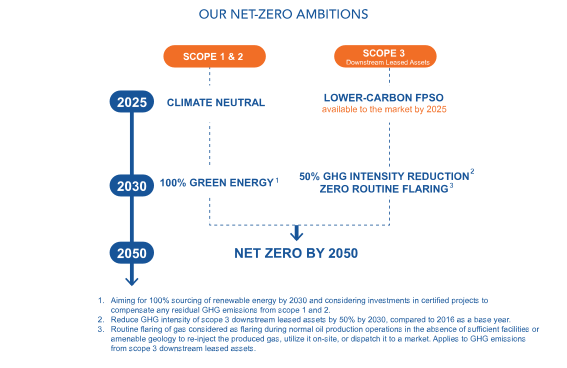
SBM Offshore is committed to a strategy and decarbonization pathway that aligns with its ambition of achieving net zero by 2050, addressing scope 1, scope 2, and scope 3 emissions from downstream leased assets. SBM Offshore has established its intermediate climate targets based on guidelines of the Science Based Targets Initiative (SBTi)1. To incorporate these long-term emission reduction targets into the business strategy, SBM Offshore develops Corporate Guidance each year that strengthens its strategic direction and goals, providing a framework for decision-making and aligning the organization around company-wide priorities for emissions management and other topics.
Scope 1 and 2 targets
- Climate Neutral by 2025;
- 100% renewable energy by 20302.
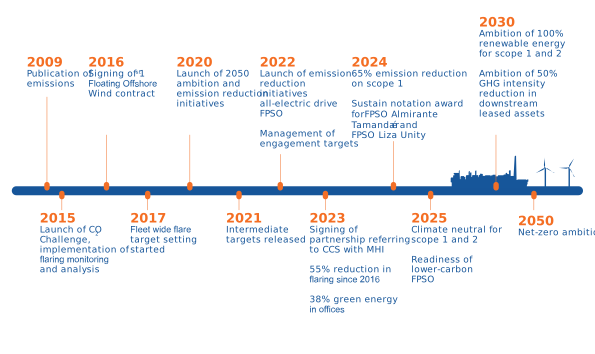
The scope 1 and scope 2 emissions targets are aligned with the 1.5°C climate pathway, which also supports the EU objective of achieving climate neutrality by 2050. SBM Offshore is making steady progress in reducing scope 1 and scope 2 emissions, having achieved climate‑neutral operations for its offices and shorebases in 2024 and successfully maintaining this status in 2025. This was enabled by the continued expansion of renewable electricity sourcing, the use of Energy Attribute Certificates (EACs), and the purchase of carbon credits to address remaining emissions where renewable energy availability is limited. This progress is driven by a focus on energy efficiency, electrification and the increased use of electricity generated from renewable resources.
In 2025, strengthened internal controls and detailed, region‑specific energy data reviews Supported the accuracy and reliability of scope 1 and scope 2 emissions data ahead of year‑end consolidation. Looking ahead, SBM Offshore is committed to sourcing 100% of its energy consumption from renewable sources through targeted procurement strategies and contractual agreements, with full implementation expected by 2030. SBM Offshore remains on track to achieve net‑zero scope 1 and scope 2 emissions by 2030.
Scope 3 targets
- Lower-carbon FPSO available to the market by 2025;
- 50% reduction in GHG intensity3 for downstream leased assets by 2030;
- Zero routine flaring4 for downstream leased assets by 2030.
SBM Offshore aspires to achieve net-zero emissions by 2050 and has set interim targets to reduce the carbon intensity of its downstream leased assets. To reach these goals, SBM Offshore is investing in innovative technologies and forming strategic partnerships to significantly lower emissions from new FPSO units while improving the efficiency of existing ones.
A key milestone achieved by SBM Offshore on its journey toward net-zero emissions is the market-readiness of a lower-carbon FPSO by 2025. The design incorporates CCS which, combined with other lower-carbon technologies, can reduce GHG emissions by up to 80% in comparison to conventional units, depending on the combination of technologies adopted. In May 2025, the American Bureau of Shipping (ABS) granted Approval in Principle for the solution after a thorough review of its design in accordance with regulatory and class requirements.
SBM Offshore is also on track to achieve a 50% reduction in GHG intensity from scope 3 emissions of downstream leased assets, compared with the 2016 baseline. Given the current industry business models, SBM Offshore recognizes that further emission reductions for downstream leased assets by 2050 will require continuous collaboration and shared responsibility across the industry, financiers, and regulators. Key actions and opportunities to meet these objectives include:
Market Uptake
Despite increasing momentum behind the energy transition, a lack of supportive policies and financing globally means that the sector is still not on a trajectory aligned with its climate goals. To collectively advance towards net zero by 2050 while contributing to a just energy transition, SBM Offshore continues to collaborate with stakeholders across the value chain, including the market, financiers, and regulators, to create a favorable policy and financing environment that encourages the development and adoption of carbon reduction, carbon removal, and lower-emission products and technologies.
O&G Decarbonization
Recognizing the need for all energy sources in the global energy mix for the foreseeable future, SBM Offshore understands that the O&G market will remain strong. Therefore, SBM Offshore makes efforts to enhance O&G production efficiency by optimizing energy use and reducing emissions from FPSOs. In partnership with Mitsubishi Heavy Industries, SBM Offshore is also developing CCS solutions for FPSOs, which is essential to enable significant GHG emissions reductions from FPSOs and represents the greatest potential for reducing their carbon footprint.
Diversification
SBM Offshore continually provides solutions that create value, meet specified performance targets, and offer high levels of delivery assurance. This comprehensive approach not only supports the successful execution of challenging projects but also strengthens the foundation for long-term partnerships. Among the various solutions contributing to a net-zero economy, SBM Offshore is actively developing carbon capture technologies for industrial users, as well as lower-carbon energy generation and renewable energy solutions, including floating offshore wind and solar power.
Research and Development (R&D)
SBM Offshore remains dedicated to its core activities while advancing toward a net-zero future by developing competitive technological solutions that significantly reduce emissions and enhance the efficiency of traditional O&G production. Additionally, SBM Offshore invests in R&D of new ocean infrastructure solutions while building strategic partnerships to develop promising sectors, such as offshore renewable energy, ammonia and hydrogen production, and alternative CCS methods for carbon-intensive industries. SBM Offshore actively innovates and proposes to the market scientifically proven low-emission products and alternative future-focused energy technology solutions needed for a more sustainable tomorrow.
Expenditures in relation to climate transition and O&G-related activities
SBM Offshore allocates a portion of its R&D expenses to the development of renewable energy products and services, as well as other low-emission products, and the decarbonization of the O&G value chain5. SBM Offshore acknowledges that, despite its efforts to enhance the technological and economic feasibility for scaling up offshore solutions, the deployment of new technologies in operational settings and the additional investments required for renewable energy offshore operations are contingent upon market demand from the power, ammonia, hydrogen and other industries. Current priorities reflect SBM Offshore’s understanding of the business landscape, which may evolve with future developments and shifts in the global market’s appetite for new ocean infrastructure solutions.
The CAPEX related to oil-related activities in 2025 is presented in in section 4.3.131. SBM Offshore does not support coal or non-associated gas activities.
PERFORMANCE
SBM Offshore’s emissions-management approach builds on many years of continuous improvement. In 2025, SBM Offshore maintained its focus on reducing scope 1 and scope 2 emissions, while also working closely with clients to identify and advance opportunities for scope 3 emissions reductions. To benchmark its operational environmental performance, SBM Offshore uses IOGP performance data, which supports target setting, progress monitoring, and comparison with industry peers.
Performance in 2025 should be viewed in the context of an atypical operational year, marked by the ramp-up of three newly commissioned FPSOs. Early operational phases typically involve higher flaring, increased emissions intensity, and temporary efficiency losses, all of which contributed to deviations from standard industry benchmarks. Despite this context, SBM Offshore continues to pursue long-term improvements in environmental performance. SBM Offshore’s 2025 performance results, compared with IOGP data, are presented below:
- GHG emissions: 145 tCO₂e per 1,000 tonnes hydrocarbon production (11% above IOGP), influenced largely by commissioning and ramp-up activities of the new FPSOs.
- Gas flared: 19 tonnes per 1,000 tonnes hydrocarbon production (114% above IOGP), reflecting normal, temporary start-up-related process instabilities.
- Energy consumption: 1.3 GJ per tonne of hydrocarbon production (15% lower than IOGP), demonstrating strong underlying energy-efficiency performance despite the temporary impacts of ramp-up operations.
GHG Emissions
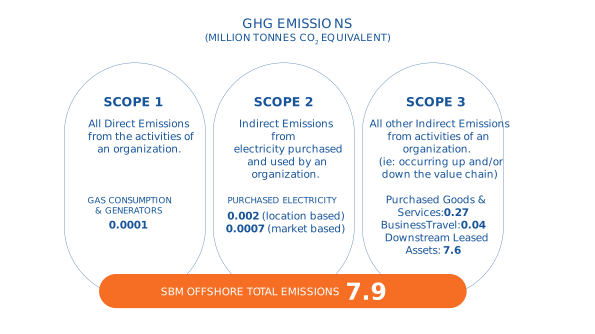
SBM Offshore calculates its GHG emissions based on the guidelines from the GHG Protocol Corporate Standard and Corporate Value Chain Standard. SBM Offshore uses the most recent Global Warming Potential (GWP) values published by the Intergovernmental Panel on Climate Change (IPCC), focusing on a 100-year time horizon to convert non-CO2 gases into carbon dioxide equivalent (CO2e) emissions. Detailed information about the methodologies and emission factors is disclosed in section 3.7.2. In 2025, SBM Offshore reported a total of 7.9 million tonnes of CO2e, which includes scope 1, scope 2, and scope 3 emissions.
Scope 1 – Direct Emissions
In 2025, scope 1 emissions accounted for virtually 0% of total emissions, amounting to 79 tonnes of CO2e, of which 54 tonnes relate to gas consumption and 25 tonnes relate to the use of diesel-powered backup generators. This was a reduction of 53% compared with 2024, primarily driven by the relocation from the Schiedam office to Rotterdam. In 2025, SBM Offshore completed the transition from its former office in Schiedam to a more energy-efficient office in Rotterdam, where gas-based heating was replaced with a city heating system using energy from waste.
SBM Offshore compensated for the remaining scope 1 emissions using verified carbon credits, detailed in 'GHG removals and carbon pricing'.
Scope 2 – Purchased Electricity (location based)
In 2025, SBM Offshore purchased a total of 5,437 MWh of electricity, resulting in location-based emissions of 1,899 tonnes of CO2e. This figure represents an 8% reduction compared to 2024, together with an 11% overall reduction in electricity consumption. The improvement was driven not only by the enhanced energy efficiency of the new Rotterdam office but also by broader operational efficiency measures implemented across SBM Offshore. These included optimized occupancy, the continued adoption of hybrid working practices that reduce operational loads, and ongoing improvements in lighting efficiency and IT power-management across multiple locations.
The emissions are calculated based on the average energy mix and the resulting emissions factor for each location, disclosed in section 3.7.2.
Scope 2 – Purchased Electricity (market based)
SBM Offshore has committed to becoming GHG neutral by 2025 and aims to utilize 100% renewable energy for its own operations (scope 1 and scope 2) by 2030, having achieved a 80% emissions reduction to date compared to its 2016 baseline. To reach these goals, SBM Offshore is primarily sourcing renewable energy for office-related operations, either through green electricity supply agreements or by using Energy Attribute Certificates (EACs).
In 2025, SBM Offshore achieved 100% renewable energy use in five offices by purchasing green electricity directly from suppliers: Amsterdam, Rotterdam, Rio de Janeiro, Monaco and Marly. For other locations – including offices in Houston, Kuala Lumpur, Porto, Singapore, Shanghai, Bangalore, shorebases in Santos, and the Test and Development Center (T&DC)1 – SBM Offshore sourced renewable energy through unbundled EACs. In markets where renewable energy was not accessible, such as Luanda, Georgetown, and Malabo, SBM Offshore compensates for the remaining emissions by purchasing verified carbon credits, as detailed in ’GHG removals and carbon pricing’.
Scope 2 market-based emissions made up 0.01% of total emissions in 2025, amounting to 708 tCO2e, a reduction of 16% compared with 2024. This change is primarily driven by reduced electricity demand following the transition to the more energy-efficient Rotterdam office, complemented by additional operational efficiency measures implemented in India, Guyana, and other locations.
Scope 3 – Purchased Goods and Services
The construction period for an SBM Offshore FPSO normally comprises up to three years. SBM Offshore applies the GHG Protocol average‑data method to estimate FPSO project emissions and uses a pragmatic approach to identify the most emission‑intensive components and materials. The GHG emissions for the assets under construction are estimated using the finance‑reported percentage‑of‑completion (POC) for the Hull (MPF) and the Topsides2 in the reporting period, following the methodology described in section 3.7.2.
In 2025, SBM Offshore had two MPFs, two topsides1, and one FSO under construction, resulting in 266,257 tCO₂e, or 3.4% of the total emissions. This represents a 1% reduction compared to 2024.
Scope 3 – Business Travel
In 2025, air travel-related emissions accounted for 0.5% of total emissions, totalling 36,096 tCO2e, an increase of 5% compared with 2024. The rise in emissions reflects an uptick in business activities, including projects and commissioning activities that necessitated key staff taking long-distance flights.
Scope 3 – Downstream Leased Assets
Emissions from downstream leased assets (FPSOs) continue to represent the largest share of SBM Offshore’s carbon footprint, accounting for 96.2% of total emissions, or 7.6 million tonnes of CO₂e in 2025. The 11% increase compared with 2024 is primarily attributed to the startup phase of three newly commissioned units during the reporting period. During these early operational stages, FPSO equipment typically operates under sub-optimal conditions while production systems stabilize, resulting in higher flaring and less efficient combustion, which temporarily increases emissions.
Relative to the 2016 baseline – when the GHG intensity of downstream leased assets was 202 tCO₂e per 1,000 tonnes of hydrocarbon produced – SBM Offshore achieved a 28% reduction, reaching 145 tCO₂e per 1,000 tonnes in 2025. Despite this long-term improvement, the 2025 intensity performance was 11% above the IOGP industry benchmark, reflecting the temporary impact of ramp-up activities of the new units. Although the new FPSO units are designed for higher energy efficiency, the combined effect of three simultaneous rampup periods led to an overall increase in emissions intensity for the year.
The energy intensity of downstream leased assets was 15% below the IOGP benchmark, demonstrating SBM Offshore’s sustained commitment to operational efficiency. Lower energy intensity directly contributes to improved emissions performance as production stabilizes. Detailed information on energy consumption volumes is provided in section 3.6.1.
SBM Offshore acknowledges that operating and upcoming FPSOs lead to locked-in emissions – emissions that are expected to occur over the asset’s lifetime due to the long-term nature of O&G projects. To enable significant emissions reductions for new FPSOs, SBM Offshore plans to improve communication on the lower-carbon features of its latest FPSO design. However, the adoption of technologies and features aimed at improving emission efficiency will depend on market dynamics and clients’ financial appetite and acceptance.
In its efforts to optimize operations and reduce emissions on the FPSOs where SBM Offshore provides operations and maintenance, SBM Offshore has set a flaring target of 1.86 million standard cubic feet per day (mmscf/d) as the fleet average for 20251. In the year, SBM Offshore achieved a gas flaring rate of 1.12 mmscf/d in 2025, a result reinforced by the continued focus on minimizing unplanned events within its operated fleet.
Energy Consumption and Mix
SBM Offshore recognizes that reducing operational CO2 emissions requires ongoing efforts to improve energy and resource efficiency, along with a clear understanding of its energy consumption per location and operation. This section summarizes the total energy consumption for own operations, noting an increase in the share of energy sourced from renewables since 2016, which is the base year for SBM Offshore’s GHG emissions targets. Detailed information about energy consumption by source and location, as well as energy production data, is available in section 3.6.1.1.
| 2024 | 2025 | Target (2030) |
|---|---|---|---|
Total energy consumption (MWh) | 7,094 | 5,972 | 100% source from renewable sources |
Total energy consumption from fossil sources (MWh) | 2,479 | 1,845 | |
Total energy consumption from renewable sources (MWh) | 4,615 | 4,127 |
Gross scope 1, scope 2, and scope 3 GHG emissions
This section summarizes SBM Offshore’s annual GHG emissions compared with the baseline year and outlines targets for emission reduction. The scope 3 target specifically focuses on emissions intensity from downstream leased assets, as emissions from FPSO operations represent most of the overall scope 3 emissions. Therefore, improving performance in this area is crucial for SBM Offshore to align with industry decarbonization pathways and climate goals.
The focus on reducing FPSOs’ emissions intensity is reinforced by emerging policies and global industry initiatives, including the World Bank’s Zero Routine Flaring by 2030 Initiative, the Global Methane Pledge, the Oil & Gas Methane Partnership 2.0, and the IOGP Energy Transition Framework. These initiatives promote lower-carbon offshore operations and emphasize the importance of addressing emissions where they have the most significant impact.
Detailed GHG emissions data for scope 1, scope 2 and scope 3 (per category) by location, along with emissions intensity data, are available in section 3.6.1.1.
| Baseline (2016) | 2024 | 2025 | Target (2030) |
|---|---|---|---|---|
Scope 1 (tonnes CO2e) | 222 | 169 | 79 | 100% Green energy1 |
Scope 2 (tonnes CO2e) location-based | 3,582 | 2,061 | 1,899 | |
Scope 2 (tonnes CO2e) market-based | 3,582 | 839 | 708 | 100% Green energy1 |
Scope 3 Downstream leased assets – GHG intensity | 202 | 118 | 145 | 50% reduction |
Scope 3 Downstream leased assets – GHG intensity | 28.3 | 16.5 | 20.4 | 50% reduction |
- 1 Applicable to emissions related to offices and subject to availability of green energy for the scope.
GHG Removals and Carbon Pricing
In 2025, SBM Offshore cancelled 787 tCO2e in remaining scope 1 and scope 2 market-based emissions by purchasing carbon credits certified under the Verified Carbon Standard (VCS). This action aligns with the best practices for carbon management outlined by the International Carbon Reduction and Offset Alliance (ICROA) Program, based on which SBM Offshore has committed to compensating for its remaining residual emissions using high-quality carbon credits.
The carbon credits used to offset residual office-related emissions in 2025 were sourced from the VCS-certified Dutch Biogas Projects in the Netherlands. These projects capture and utilize biogas produced from residual products from the food industry and manure, preventing methane emissions that would otherwise be released into the atmosphere. By converting recovered biogas into renewable energy, the projects deliver measurable reductions in GHG emissions. Beyond their positive climate impact, the projects also strengthen local waste-management practices, support circularity within the agricultural sector, and create positive socio-economic benefits for surrounding communities.
All emissions reductions were independently verified under the VCS, ensuring the credibility, accuracy, and traceability of the carbon credits. SBM Offshore remains committed to prioritizing emissions reductions wherever possible and offsetting unavoidable residual office-related emissions with high-quality, independently verified carbon credits that generate meaningful environmental and social co-benefits.
Currently, SBM Offshore assesses carbon-related risks and opportunities but does not integrate an internal carbon price into its financial or operational decision-making processes. SBM Offshore continuously monitors policy and regulatory developments and industry best practices to evaluate the potential relevance of carbon pricing as a tool for future climate-related risk management and strategy development.
FUTURE
SBM Offshore is committed to advancing its decarbonization efforts through targeted initiatives:
- Scope 1 and 2 emissions: continue to prioritize energy efficiency improvements and increase the use of electricity from renewable sources across onshore facilities. In locations where renewable supply is not yet available, SBM Offshore is evaluating opportunities for on-site renewable energy generation to further reduce emissions.
- Scope 3 emissions: to support continued reductions in GHG emissions from O&M service agreements, SBM Offshore remains actively engaged with internal stakeholders and clients to minimize flaring and improve energy efficiency by leveraging digital tools.