3.3.1Our people
ESRS 2 SBM-2; SBM-3; IRO-1, and ESRS S1
MATERIAL IMPACTS, RISKS, AND OPPORTUNITIES (IRO)
SBM Offshore has identified key material impacts, risks and opportunities related to Our People resulting from the DMA. This information guides SBM Offshore in continuously improving the management of Our People issues associated with its operations and value chain, as further discussed in this section.
Our People material impacts, risks and opportunities
|
|
|
|
|---|---|---|---|
Our People | |||
Positive impact | Increased employee satisfaction. | own activities | short-term |
Opportunity | Higher attraction of talents and new workforce to work in new era of renewables and more digital energy industry. | own activities | short-term |
Higher employee engagement from standardized and improved ways of working and strengthened collaboration. | own activities | short-term | |
Risk | Potential inability to retain SBM Offshore’s employees based on working conditions, including stress issues. | own activities | short-term |
Potential hazard of harassment or discrimination due to nationality, gender, ethnicity, social and legal status, race, religion, or other protected status, in SBM Offshore’s own workforce. | own activities | short-term | |
OUR Approach
Policies and Governance
SBM Offshore places its people at the core of its activities, emphasizing their role in driving excellence and creating lasting value. SBM Offshore’s strategy focuses on sustainable and collaborative work environments to develop employees’ skills and support growth and fulfillment. This commitment is reflected in policies1 grounded in SBM Offshore’s core Values and Code of Conduct, updated in July 2025, which promotes an ethical, inclusive and transparent culture, essential for sustainable performance and stakeholder trust. These policies include those on inclusion, diversity, equity, data protection, Speak Up, and human rights, supported by ongoing training and communication initiatives.
The responsibility for overseeing Our People policies and processes rests with the Group HR Director, who is also a member of the Executive Committee.
PERFORMANCE
Our People at a Glance
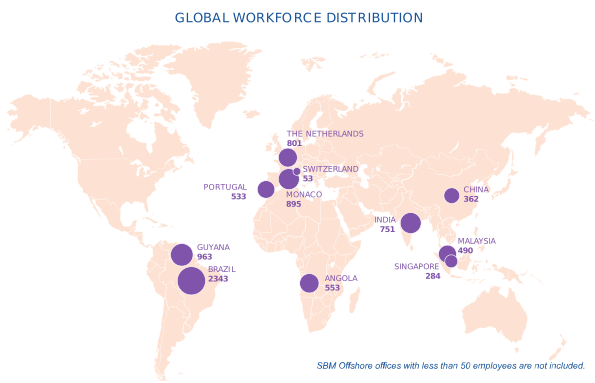
As of December 31, 2025, SBM Offshore employed 8,178 people across 23 countries on five continents.
The workforce is also divided by workplace:
- 67% work onshore and 33% offshore.
- 68% are in the age group 30-50 years old.
- 23% are women.
- Most employees are located in Brazil (32%).
In 2025, among the 1,110 employees hired:
- 61% are aged 30-50 years old.
- 32% are women.
- 66 nationalities.
Employee Engagement and Value Proposition
SBM Offshore conducted its biennial Pulse Survey in 2025, achieving an employee engagement score of 88% with high participation across demographics, including offshore employees. The engagement strategy is leadership-driven and integrates insights from surveys and employee lifecycle touchpoints, including global and local town halls. SBM Offshore updated its Employee Value Proposition (EVP) in 2025 to align with the new corporate narrative, adopting the strapline ’Your Growth. Our Future’. This EVP emphasizes creating experiences that unlock employee growth and supports attraction and retention efforts. The updated EVP was launched at an HR seminar in May 2025, with an activation plan integrating concrete actions throughout the employee journey.
Competency-Based Management
In 2025, SBM Offshore successfully deployed the Job and Competency Referential (JCR), defining role descriptions, grade ranges and competencies across the organization. The next phase planned for 2026 involves integrating this referential into the Learning Management System and Career Path modules. This approach fosters a culture of self-development where employees actively participate in their growth, supported by a leadership committed to the development of their people. The transformation aims to enhance engagement, attract new talent, improve retention, and provide transparent career opportunities and consistent development paths.
Workforce Optimization Initiatives
SBM Offshore promotes standardized and collaborative practices to optimize the professional environment and value talent as performance drivers. The Fast4Flex project focuses on restructuring the contingent workforce, approximately 16.5% of total payroll, supporting flexibility and specialized expertise. The project completed its initiation and planning phase in 2025 and entered execution. The Global Workforce Planning (GWP) project enables effective planning, deployment, and support of people to meet business needs. Additionally, the Corporate and Business Solutions Center (CBSC) expanded globally in 2025, enabling teams to leverage expertise and share best practices internationally. Remuneration practices ensure fair and adequate pay aligned with local laws and benchmarks, using the Hay methodology to minimize gender pay gaps. Work-life balance initiatives include competitive benefits, family support, flexible working arrangements, and paid social leave tailored to local needs.
Inclusion, Diversity, and Equity (IDE)
In 2025, SBM Offshore conducted an internal awareness campaign to strengthen understanding and importance of Inclusion, Diversity and Equity (IDE), further to the update of the IDE Policy in 2024. Concrete initiatives included learning awareness campaigns, diversity ambassador training, and integration of key IDE indicators into management practices. These efforts have enhanced a culture of inclusion and respect while actively combating discrimination and harassment. Evaluation practices now incorporate IDE reflections to promote accountability, and recruitment processes have been strengthened to embed IDE principles in talent attraction and onboarding.
FUTURE
SBM Offshore’s recent deployment of Competency-Based Management marks a profound transformation in SBM Offshore’s human capital management. SBM Offshore plans to deepen its learning culture by embedding competency-based approaches throughout the HR cycle, guided by the 70/20/10 learning model emphasizing learning by doing, from others, and formal training as needed. The ongoing integration of competency referential tools is expected to further empower employees’ self-development, strengthen engagement and satisfaction, support talent attraction and enhance retention through transparent career paths and equitable work practices.