3.3.2Health, safety and security
ESRS 2 SBM-2; SBM-3; IRO-1, and ESRS S1-14
MATERIAL IMPACTS, RISKS, AND OPPORTUNITIES (IRO)
SBM Offshore has identified key material impacts and risks related to Health, Safety and Security resulting from the DMA. This information guides SBM Offshore in continuously improving the management of Health, Safety and Security issues associated with its operations and value chain, as further discussed in this section.
Health, Safety and Security material impacts and risks
|
|
|
|
|---|---|---|---|
Health, Safety and Security | |||
Positive impact | Embedding safe working conditions. | own activities | short-term |
Risk | Potential work-related fatalities, injuries, and illnesses due to acute or chronic exposure to activity-related hazards, which may pose human capital, reputational and financial risks. | own activities and downstream and upstream value chain | short-term |
Potential oil spills due to acute or chronic exposure to activity-related hazards, which may pose environmental, reputational and financial risks. | own activities | short-term | |
Our ApproacH
Policies and Governance
Recognizing the nature of its business, SBM Offshore has adopted a Sustainability Policy, integrating commitments across Health, Occupational Safety, Process Safety, Security, Environmental Stewardship, Human Rights, and Social Impact Management.
SBM Offshore strives to maintain an injury-free workplace for all personnel – employees, contractors, and subcontractors – by managing risks and critical controls at every organizational level. Risks are identified and assessed throughout the lifecycle of projects, with controls implemented to minimize incidents, including major accidents and their consequences.
SBM Offshore has established a Management System Assurance framework that adheres to the standards for which the Organization is certified and compliant. SBM Offshore is certified by the International Safety Management Code (ISM), the International Ship and Port Security (ISPS) and ISO 9001:2015. The management system is also compliant with the ISO 14001:2015 and ISO 45001:2018. To uphold high standards of integrity and transparency, SBM Offshore engages accredited third-party or independent, qualified auditors to perform comprehensive periodic external audits, which covers the root cause assessment of the identified non-conformities, as well as preventive and corrective actions to stimulate continuous improvement (see section 3.6.4 – Certification table).
SBM Offshore is committed to its Target Excellence ambition, focusing on three core objectives: No Harm, No Defects, and No Leaks. This ambition safeguards people (both SBM Offshore employees and contractors) and assets while addressing environmental and climate impacts. The key priority is eliminating Fatalities and Permanent Impairments (FPI). Strategies are aligned with IOGP recommended practices on FPI prevention and Human Performance1, reinforcing a safer and more sustainable workplace.
This commitment is highlighted annually through Life Day, celebrating and protecting life across SBM Offshore operations. Every individual has both the right and responsibility to stop work if activities conflict with the Sustainability Policy, reinforcing collective accountability for safety.
Health and safety hazards are managed through a lifecycle hazard management process integrated within the Global Enterprise Management System (GEMS). This process applies to all projects and begins with hazard identification. Risks are assessed and controlled. When elimination of the hazard is not feasible, risks are reduced to ALARP (As Low As Reasonably Practical) levels following the hierarchy of controls. Continuous monitoring, review, and lessons learned complete the cycle. Specialized training enables process effectiveness.
Contractors undergo the supplier qualification request including prescreening on their health, safety, security, and environmental (HSSE) management procedures, as well as reviewing their safety statistics and compliance with industry standards such as ISO 45001. In addition, all contractors are required to participate in specialized safety training programs designed to enhance their competence and awareness of workplace hazards. These training sessions cover essential topics such as safety induction, permit-to-work procedures, and task risk assessments, enabling contractors to be prepared to operate safely and effectively within SBM Offshore’s operational environment.
In a world of evolving threats, SBM Offshore prioritizes security for personnel and assets, conducting risk assessments for projects in high-risk regions and implementing tailored security measures. Guidelines, interactive tools and on-demand training support these efforts.
SBM Offshore has developed its Emergency Response Plan Process, available in GEMS, according to the ISM – Code and ISO 14001 and ISO 45001 standards, which are standards that SBM Offshore is certified to and complies with. This covers points such as training, plans and simulations covering identified scenarios, communication protocols with stakeholders and the definition of emergency teams.
Employees’ health and wellbeing programs are managed at corporate level, reporting to the HSSEQS Director, ensuring integration of these disciplines into daily operations, and reinforcing SBM Offshore’s value of Care.
Performance
HSSE performance is measured through indicators benchmarked against the energy sector and internal analysis. Targets are defined collaboratively by Operations and Projects Management and approved by the Management Board. SBM Offshore aims to rank among the top 10% of IOGP members in Occupational and Process Safety by 2030.
2025 Targets and performance
| 2025 Target | 2025 Performance | Details |
|---|---|---|---|
Fatalities and Permanent Impairments (FPI) | 0 | 0 | section 3.7.3 |
Lost Time Injuries Frequency Rate (LTIFR) | na | 0.32 | na |
Tier 1 PSE with more than 3 severity weight points as per API 7541 | <1 | 1 | section 3.7.3 |
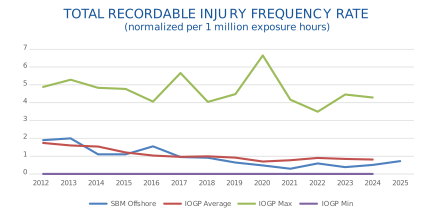
Total Recordable Injury Frequency Rate (TRIFR) | <0.50 | 0.72 | section 3.7.3 |
Occupational Illness Frequency Rate (OIFR)2 | na | 0.02 | section 3.7.3 |
Security incidents | na | 13 | na |
- 1 Tier 1 Process Safety Events are further classified using the API 754 Severity Weighting methodology, which scores severity points to each PSE Tier 1 events based on defined consequence categories.
- 2 For employees.
SBM Offshore has adopted the IOGP methodology for FPI prevention, updating procedures and KPIs to focus on achieving zero FPI. While TRIFR is still tracked, it is no longer a target but a reference for benchmark purposes. Monthly reports and critical analysis are performed and shared to track the results and assess the HSSE programs’ effectiveness. Critical analysis promotes corrective actions whenever they are needed. HSSE campaigns and promotions are implemented to raise awareness about Safety and reinforce a learning culture.
In 2025 SBM Offshore further expanded its HSSE and Process Safety initiatives:
Health
- Redesign of the global medical surveillance program (medical protocols based on health risk assessment HRA and local regulations alignments).
- Mental Health and Wellbeing framework has been embedded in GEMS, supporting a structured wellbeing matters program in each company location.
- Introduction of a new digital solution for mental health promotion and supported global roll out, available for all employees, contractors and families (Kyan Health App) with almost 900 people actively using the program.
- Wellbeing champions continuous training plan implemented, with new volunteers trained and refresher courses run for existing ones.
- Monthly health promotion agenda deployed globally, fostering a culture of wellbeing, encouraging preventive care, and empowering employees to take proactive steps toward healthier lifestyles.
Safety
- Development of a framework to implement Human Factors2 in the life cycle of SBM Offshore projects, from design to decommissioning, aligned with IOGP Recommended practice 454.
- Investment in training: more than 600 people were trained in Dropped Objects prevention; more than 100 enrolled in Human Factors technical training, and more than 150 leaders were trained in the FPI program.
- Revision of the Human Factors and Performance charter with reinforcement of the principles during Life Day 2025 and along the year during participative safety campaigns.
- Revision of FPI Instruction and reinforcement of VCC (Verification of Critical Controls) with more then 300 verifications carried out by leaders recorded in the system.
- Safety campaigns released in 2025: Dropped object hazard hunts, psychological safety learning sessions for leaders, error prone situations identification, barriers management, contractor’s engagement and Safety Everywhere (targeting off-the-job safety and offices personnel).
- Several classes of SLIA (Safety Leadership in Action) training offered across the organization, covering the main ongoing projects.
- Actively participated in the improvement of industry standards through IOGP work groups focused on FPI and the Human Performance Subcommittee.
- Implementation of High Value Learning moments where the lessons learned from the most relevant incidents are shared with all the employees during live sessions with open discussions.
- Ensured compliance with certification requirements for both onshore bases and offshore units.
The following graph illustrates that SBM Offshore’s TRIFR has consistently remained below the average of the IOGP since 2018. This achievement is a key component of SBM Offshore’s commitment to being in the top 10% of the IOGP benchmark by 2030. Regarding FPI, this KPI only began to be measured at SBM Offshore in 2024, and since then there have been no recorded Fatalities or Permanent Impairment injuries.
Security
- Risk assessments for projects in high-risk areas or countries, such as Nigeria and Mexico.
- Security guidelines published on the security sharepoint.
- Interactive PowerBi security risk rating map developed and displayed on the security sharepoint.
- On-demand training developed and delivered for specific missions in high-risk areas.
- Weekly newsletter on maritime security.
- Specific security plans according to location characteristics: SBM Offshore established security mitigations according to the country where its employees are assigned to work.
Process Safety
- Implemented the Group Performance Standard process review, verifying that appropriate controls are in place for safety barriers in relation to SBM Offshore’s inherent hazards.
- Continued to uphold the Hazards and Effects Management Process (HEMP) by effectively managing the risks associated with Major Accident Hazards (MAHs) and their potential Major Accident Events (MAEs).
- Implemented the first four modules of the Process Safety Training program, including Awareness, Introduction to PSM, HEMP, Incident classification and Case study.
- Revision of the Major Hazard Management charter updating SBM Offshore’s commitments with the identification, assessment and control of the major hazards.
Environment
In 2025, SBM Offshore outperformed the IOGP benchmark (2023 benchmark) on the following two environmental indicators:
- Number of oil spills to sea per unit of production, as no oil spills to sea above 1 barrel were reported in 2025.
- Quantity of oil discharges to sea from produced water per hydrocarbon production which was 2.71 tonnes per million tonnes of hydrocarbon produced, remaining 77% below the IOGP benchmark value and outperforming SBM Offshore’s commitment to remain 50% below the IOGP benchmark value.
SBM Offshore continues to prioritize the health, wellbeing, and safety of its employees. Throughout the year, SBM Offshore expanded awareness initiatives, training programs and related activities, while strengthening process safety measures. These efforts aim to raise awareness and enhance competencies across the organization, fostering a culture of care and resilience.
future
SBM Offshore has defined the following 2026 targets:
- Zero Fatality or Permanent Impairment Injury.
- Zero PSE Tier 1 events with more than 3 severity points, as per API 754.
SBM Offshore has planned the following key initiatives for 2026, based on critical analysis and a continuous improvement approach:
- Keep promoting the Target Excellence ambition, increasing visibility of strategic objectives and adherence throughout the organization (No Harm. No Defects. No Leaks).
- Progress in occupational safety with the FPI prevention program and its related initiatives.
- Implement IOGP Recommended Practice 810: Human Performance Framework supporting human factors and performance principles are embedded in the management system and fully implemented across the organization.
- Maintain security controls on SBM Offshore’s activities: continually driving improvements on procedures and practices to maintain thorough security controls on its activities.
- Maintain compliance with certification requirements on shorebases and offshore units.
- Continuing to increase health and wellbeing awareness, training and related programs.
- Improvement actions for employee mental health and wellbeing:
- Enhance country-specific Wellbeing Matters program.
- Maintain and enhance SBM Offshore’s medical surveillance program for better health and well-being for all (SDG3).
- Keep developing and enhancing the process safety management framework by deploying the new versions of the Group performance standards for Safety and Environmental Critical Equipment (SECE) in the execution and operations phase.
- Continue the PSM training program by delivering the remaining modules.
- Implement the Human Factors Engineering framework ensuring alignment with IOGP recommended practice 454.
- Keep and enhance Life Day in all projects, operations and offices.