1.1.3Performance Summary
Over the years, SBM Offshore has matured its performance management, data control, target setting and reporting – most notably from 2014 – using the Global Reporting Initiative (GRI) as the main framework, which integrates business and Environmental, Social and Governance (ESG) topics in one Materiality Assessment.
The last Materiality Assessment was conducted in 2023 and is renewed every four years. In the intervening years, when necessary, SBM Offshore makes updates to the assessment in light of shifts in the surrounding context, including relevant changes in economic, environmental and social impacts.
Reporting Structure
According to the European Sustainability Reporting Standards (ESRS), the sustainability information shall disclose the material data, and distinguish between information required by the Standards and other information included in the report.
The topics included in the report are embedded and reflected in SBM Offshore’s strategy, processes and plans. In the 2024 report, in order to comply with the ESRS requirements and to provide a clearer narrative, the 12 topics resulting from the 2023 Double Materiality Assessment (DMA) were divided into two main categories and chapters: Business and Sustainability. This approach has been also adopted for this 2025 report.
Included in chapter 1, along with an explanation of SBM Offshore’s business context, are the six topics purely related to the business and strategy: Energy Transition; Operational Excellence and Quality; Digitalization; Innovation; Market Positioning; and Economic Impact.
The remaining six topics assessed as material in accordance with the ESRS are presented as Material Topics and reported in the Sustainability Statement (chapter 3).
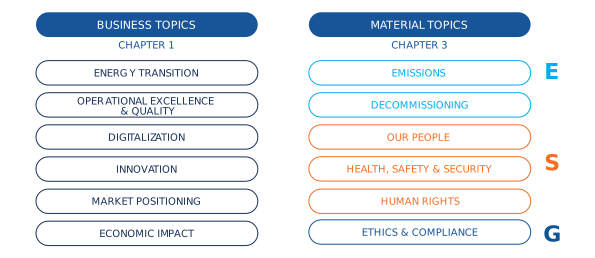
Last year, the Management Board and Supervisory Board members were consulted and validated the changes to the reporting structure. SBM Offshore is confident that the actual structure provides a clearer understanding of the business, management approach and performance.
MATERIAL TOPICS OVERVIEW
To provide a concise summary and quick overview of the material topics, the table below aims to present the key policies, targets, metrics and performance. Each material topic is further detailed in its respective section in chapter 3 – Sustainability Statement.
| |||
|---|---|---|---|
Key Policies | Key Objectives/Targets | Key Performance Indicators | 2025 Results |
Environmental | |||
SDGs related: 7, 8, 9, 13 and 14. | |||
Sustainability Policy | Enhance energy efficiency and reduce emissions. | ||
Climate Neutral by 2025 for Scope 1 and 2 (market-based)1. | Scope 1 and 2 GHG emissions (tonnes of CO2e) | Delivered since 2024 | |
Source 100% renewable energy by 2030 for Scope 1 and 22. | Scope 1 and 2 energy consumption from renewable sources (%) | 69% | |
50% reduction in GHG intensity for Scope 3 – Downstream Leased Assets by 2030 vs. 2016 baseline3. | Reduction in GHG emissions intensity for Scope 3 – Downstream Leased Assets (%) | -28% | |
Lower-carbon FPSO available to the market by 2025. | Lower-carbon FPSO available to the market. | Delivered in 2025 | |
Decommissioning (section 3.2.3) | |||
Responsible Recycling Policy | Safe and sustainable recycling applying the EU Ship Recycling Regulation (or equivalent). | ||
Development of Decommissioning and Recycling (D&R) strategic plans for offshore production facilities4. | D&R strategic plans developed for target units5 (%) | 100% | |
Social | |||
SDGs related: 3, 4 and 8. | |||
Code of conduct Inclusion, Diversity & Equity Policy Sustainability Policy | Attract and empower a diverse, skilled, and high-performing workforce that drives employee growth and supports long-term business success. | ||
Promote an ethical, inclusive, and engaging work environment that empowers people. Strengthen competency-based management. Optimize workforce & performance. | New hires ratio (%) | 15% | |
Employee turnover rate (%) | 8% | ||
Average of training hours per employee | 37 hours | ||
Engagement score in Pulse Survey (%) | 88% | ||
Sustainability Policy | No Harm, No Defects, No Leaks | ||
0 FPI. | Fatalities and Permanent Impairments (FPI) | 0 | |
Below 0.50. Below the IOGP benchmark: 0.81. | Total Recordable Injury Frequency Rate (TRIFR) | 0.72 | |
NA | Lost Time Injuries Frequency Rate (LTIFR) | 0.32 | |
Below 1. | Tier 1 PSE6 | 1 | |
NA | Maintained ISO certifications | 100% | |
NA | Oil spills above 1 bbl7 (#) | 0 | |
50% below the IOGP benchmark. | Oil-in-water discharge to sea | 2.71 | |
Human Rights (section 3.3.3) | |||
Code of Conduct Sustainability Policy SBM Offshore’s Human Rights Standards Modern Slavery Statement Supply Chain Charter | Fully embed human rights and social performance within SBM Offshore to achieve no harm. | ||
Suppliers Human Rights Due Diligence | Suppliers qualified during the year who signed the Supply Chain Charter8 (%) | 100% | |
ABCD criticality suppliers qualified during the year assessed on human rights as part of the qualification process9 (%) | 100% | ||
Yards Human Rights Due Diligence | Active yards undergone a human rights due diligence assessment (%) | 100% | |
Active yards with non-conformity items with an action plan in place (%) | 100% | ||
Governance | |||
SDGs related: 8. | |||
Code of Conduct Business Ethics Policy under Code of Conduct Speak Up Policy Privacy Policy | Zero tolerance for bribery, corruption, fraud or any other form of misconduct. | ||
Zero‑tolerance stance toward bribery, corruption, fraud, breaches of trade sanctions, money laundering, and any form of unlawful or unethical behavior. | Confirmed cases of corruption (#) | 0 | |
Reports received under SBM Offshore’s Speak Up Policy (#) | 189 | ||
Code of Conduct training. | Compliance training hours completed (#) | 3,537 | |
- 1 Balancing emissions associated with market-based office-related emissions.
- 2 Including the use of certified climate projects to compensate any residual scope 1 and 2 emissions.
- 3 The 2016 base year considers the emissions performance of 202 kg CO2e/tonnes of HC.
- 4 D&R strategic plans are a set of actions and a framework to ensure viable and timely cleaning, dismantling, and recycling options.
- 5 Target units in 2025 are the offshore production facilities with cessation of production expected by 2029: FPSOs N'Goma and Espirito Santo.
- 6 Tier 1 PSE with more than 3 severity weight points as per API 754.
- 7 Based on IOGP definition.
- 8 All suppliers included.
- 9 Criticality ’E’ is assigned to suppliers and items that do not have critical issues related to Health and Safety, Environment, Cost, Schedule, or Reputation criteria, and therefore are not included in the severity and likelihood criticality rating process.